

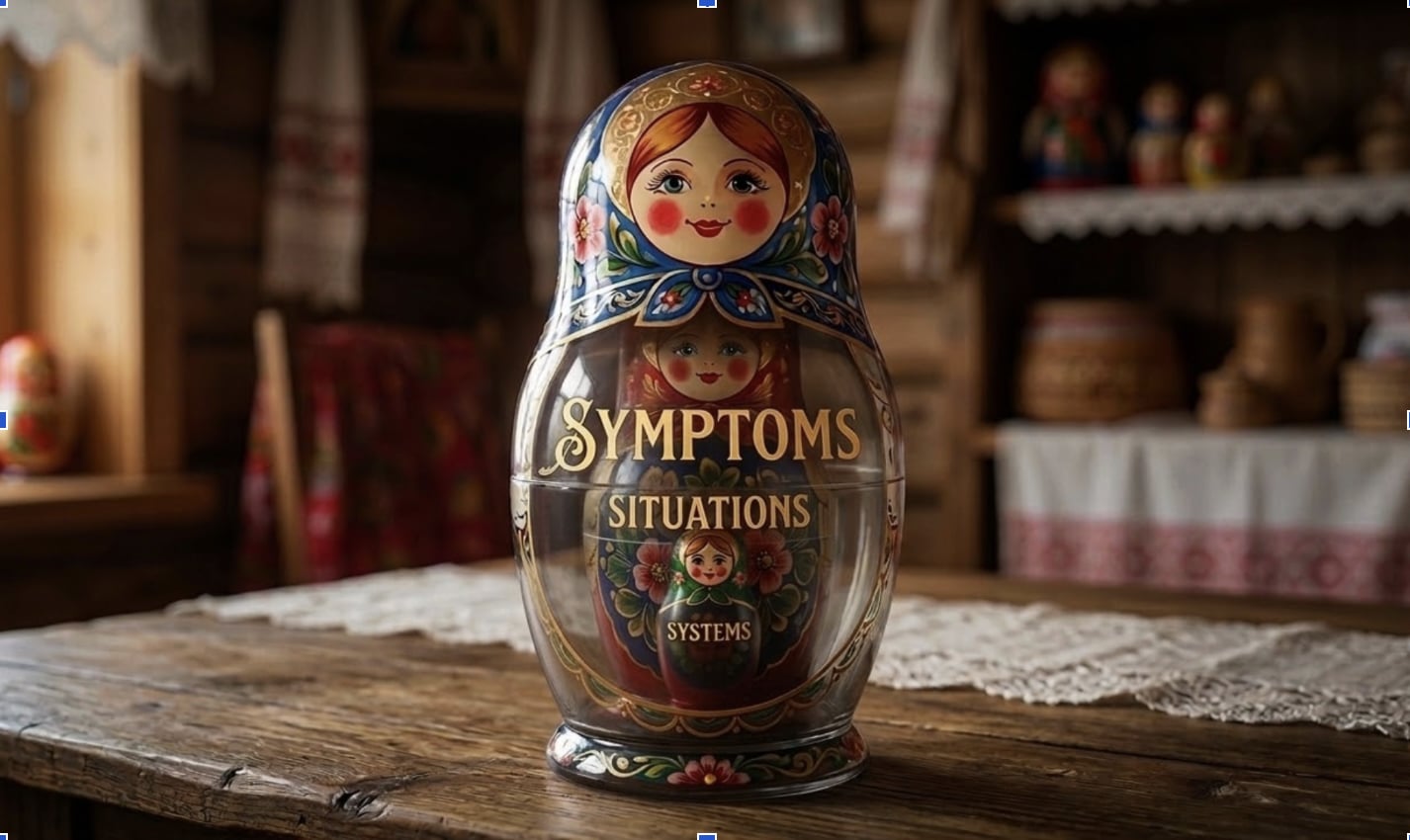
As social impact leaders, we are constantly navigating a complex landscape of challenges and opportunities during a unique period of prolonged disruption. We need a straightforward way to make sense of the moment. Here at Creation in Common, we use: Symptoms, Situations, and Systems.
Think of these elements as a set of Russian nesting dolls. They live within one another, each layer containing the next. But unlike wooden dolls, these layers are alive and dynamic. They constantly affect, inform, and reinforce each other.
- Symptoms (The Outermost Doll): These are the immediate, visible pain points or sudden wins—like a disengaged board member or an unexpected surge in volunteers. Symptoms are real and demand a response, but they aren’t the root cause. Treating only a symptom is like putting a Band-aid on a structural fracture. They are informed by situations and reinforced by systems.
- Situations (The Middle Doll): These are the specific, localized contexts where symptoms flare up or opportunities emerge—the container of the work, such as the structure of your weekly staff meeting or a recent leadership transition. They are informed by both the symptoms they produce and the systems that govern them.
- Systems (The Innermost Doll): These are the deep, underlying structures, mental models, and power dynamics that shape everything else. Systems are the unspoken assumptions and deeply ingrained culture. They create situations and sustain symptoms.
You don’t have to start at the outermost layer. The most effective way to use this tool is to start exactly where the issue—or the possibility—is appearing to you, and then map dynamically: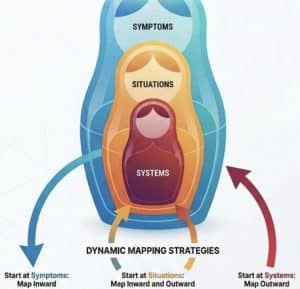
- Start at Symptoms – Map Inward – When facing a surface-level win or loss, ask: “What localized Situation is containing this symptom, and what underlying System is fueling it?”
- Start at Situations – Map Inward and Outward – When examining a recurring pattern, ask: “What visible Symptoms is this situation producing, and what deeper System was it built to serve?”
- Start at Systems – Map Outward – When identifying a root assumption or cultural shift, ask: “How is this system designing our daily Situations, and what Symptoms are bubbling up as a result?”
The next time you’re faced with a complex reality, don’t just look at the one doll you happen to be holding. Pause. Examine the whole set. Then take action.